Can I see my therapist if I travel or move out of state?
Often yes, you can see your therapist if you are in another state, but it depends on where you are, not where your therapist is. Therapy licensing follows the client’s physical location during each session. If your therapist is licensed in say Texas and you’re sitting in Colorado, they will need to be allowed to practice in Colorado for that session to be legal. That surprises a lot of people, especially with online therapy, where it feels like location shouldn’t matter. It still does. The good news is that the options have expanded a lot, and for psychologists in particular, moving or traveling no longer has to mean starting over with someone new.
Why your location matters
Each state licenses its own mental health professionals and sets its own rules, partly to protect clients. Your therapist needs to know the laws, emergency resources, and reporting requirements for the place you’re actually in. That’s also why I’ll ask where you are at the start of each session. If something urgent came up, I’d need to know which local emergency services to contact.
What PSYPACT changes
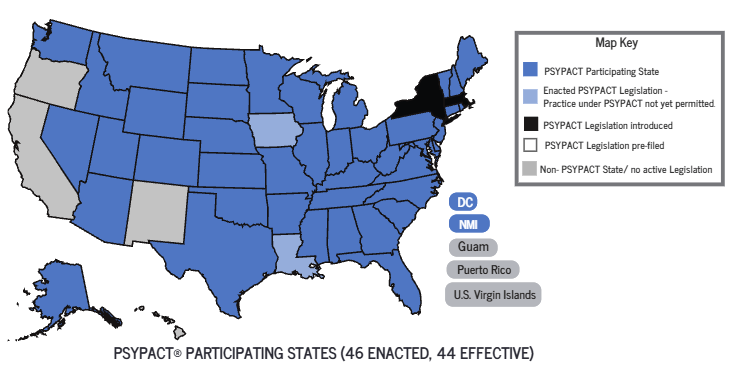
PSYPACT is an agreement among more than 40 states that lets authorized psychologists provide telehealth to clients in any participating state. I’m licensed in Texas and PSYPACT authorized, so if you’re in a participating state, we can work together. If you move from Texas to another PSYPACT state, we can usually just keep going.
PSYPACT APIT #25805
One thing worth knowing: PSYPACT covers psychologists only. Counselors, social workers, and marriage and family therapists have their own separate compacts at different stages of rollout, so if you see one of them, ask what applies to their license.
If you’re traveling
A trip within Texas changes nothing. Out of state, it depends on whether that state participates in PSYPACT, and some states also allow brief temporary practice for visitors. Tell your therapist where you’ll be before you leave, not the morning of the session, so there’s time to check. Outside the U.S., sessions are generally not possible, since foreign licensing and privacy laws apply.
If you’re a college student
This is one of the most common situations I see. If you go to school in Texas but spend summers and breaks at home in another state, PSYPACT often means we don’t have to pause during breaks. That continuity matters. Breaks are frequently when things get harder, not easier.
If you’re moving
If your new state participates in PSYPACT, we can usually continue without interruption. If it doesn’t, I’ll help you find someone licensed there and make the handoff as smooth as possible, including sharing records with your permission. Ending well is part of good care.
What about insurance?
Licensing and insurance are separate questions. Even when I can legally see you in another state, your insurance may not cover it, since networks are often state-specific. In practice, out-of-state sessions are usually self-pay, though a superbill may help you get partial reimbursement through out-of-network benefits. Make sure in check with your insurance provider ahead of time.
What to ask your therapist
- Are you licensed or authorized where I’ll be?
- Does my insurance still apply there?
- What happens if I move permanently?
- Do you need my location at the start of each session?